Web Analytics Business News This Week Budget | Business News This Week
Showing posts with label Budget. Show all posts

Feb 28, 2015

Post Budget Reaction comment from Insecticides India Ltd.

IN · · Leave a Comment
Mr. Rajesh Aggarwal, Managing Director, Insecticides India Ltd
Mr. Rajesh Aggarwal, Managing Director, Insecticides India Ltd said ,”The Finance Minister has rightfully recognized the stress on agriculture incomes and put emphasis on investing in rural infrastructure. The allocation of Rs. 5,300 crore towards micro-irrigation, watershed development initiatives is a particularly welcome measure.

We all know that a bulk of our population is dependent on the farm sector and the farm sector in turn is heavily dependent on the monsoon. A rainfall deficit always affects the farm sector and the agro chemical industry. This dependence on monsoon should reduce and we need a thrust on building micro-irrigation facilities which is there in the budget.


Another positive scheme that the government has announced is the soil health card scheme that aims to improve soil fertility. We are optimistic about this scheme and believe it will be highly beneficial to farmers. Besides, we also appreciate the budget’s thrust on manufacturing in line with ‘Make in India’.
Read the rest of this entry

Post Budget Reaction comment from Koenig Solutions

IN · · Leave a Comment
Mr Rohit Aggarwal, Founder and CEO of Koenig Solutions.
Mr Rohit Aggarwal, Founder and CEO of Koenig Solutions said, “We genuinely welcome the budget’s emphasis on giving a friendly environment and financial incentives to business start-ups, especially in the IT sector. The FM has proposed Rs 1,000 crore to help IT start-ups, and support funding needs of small firms. The FM rightly recognized the IT sector as one of India’s leading employers in the services sector. The financial proposal will boost entrepreneurship in the IT sector and create more jobs.

This is a manufacturing friendly budget, very much in line with the ‘Make in India’ thrust. From the point of view of the IT industry specifically, the streamlining of the Special Additional Duty will pave way for local manufacturing benefits to some IT products.

Overall, it is a positive growth friendly budget that gives the right direction to the economy by giving incentives to business, infrastructure and manufacturing. The proposal to reduce corporate tax from 30 % to 25 % for the next four years will give a healthy boost to spending, business and employment generation.
Read the rest of this entry

Jan 29, 2015

IIC submits representation for 2015 Budget to Govt

IN · · Leave a Comment
Impact Investors Council (IIC), an industry body to promote impact investing in India, today submitted a representation for the forthcoming Budget to the Minister of State for Finance, Shri Jayant Sinha, on behalf of the investors and social entrepreneurs, seeking recognition for the Rs 10,000-crore sector, and easier financing for social enterprises.

Impact Investors invest in social enterprises, which are working to create social and environmental change in the country.

Impact investing essentially involves investing with the implicit intention of generating positive social impact along with a return on capital. It ends the old dichotomy, which saw business as simply a way to make profit, while social progress was best achieved through charity or aid.

Impact investment has been growing at a rate of 27%in India over the last seven years, and 30+ impact investment funds in the country have invested a cumulative amount of $1.6 billion in 300+ social enterprises and across a range of industries such as financial inclusion, agribusiness, healthcare, education and clean energy, among others[1].

Social enterprises in India have exemplified the power that businesses can do ‘good’ while creating value for themselves. However, they have found it challenging to source institutional capital, especially in their initial years. Impact investing has played a key role in filling the crucial gap of financing social enterprises in India.

“Impact Investors have used the power of financial markets and ingenuity of social entrepreneurs to build Rs 10,000 crore impact investment industry with a promise to exceed Rs 6,000 crore annually by 2020. The industry helps bridge our national social investment gap while serving the poor and underserved. Therefore, IIC is requesting the Government to partner us and help galvanize the impact investment eco-system,” said Amit Bhatia, Chief Executive Officer, IIC.

In its first ever member-only convention, the board members of the council presented the priority areas that need immediate attention from the government to boost the impact investing activity in India. IIC requested for the following:

1. Official recognition of impact investors, social enterprises and IIC

2. Review of social venture fund (SVF) guidelines

3. Extending priority sector lending to social enterprises

4. Increasing access to External Commercial Borrowing (ECB) funding by social enterprises

5. “Panel Member” on the high level committee on Corporate Social Responsibility (CSR) and social impact assessment measures.

The number of impact investors-funded social enterprises is expected to reach 1,000 by 2020. The staggering growth is on the back of impact investment, which is estimated to cross $6 billion or Rs 40,000 crore by 2020, while the annual figure is likely to exceed $1 billion in the next five years. The cumulative investment of Rs 10,000 crores positions India as one of the largest impact investment destinations in the world[2].

IIC is working towards the goal of reducing information asymmetry in the impact investing sector. The council has helped in establishing a working definition of impact investing that outlines the contours of impact investing and an impact investor in India. It has also put forth a comprehensive view on the quantum of impact investing across years, sectors and stages of enterprise growth. In addition to these activities, IIC is currently working towards developing national standards for impact assessment and measurement.
Read the rest of this entry

Aug 4, 2014

Top 10 Most Expensive Cities in India

IN · · Leave a Comment
When people want to relocate to a new place there arises a question in their mind as to the expenses and cost of living in that place.

In the recent times there is an increase in the number of people who want to relocate to a new place. Reasons may differ but it is always helpful if you know what the most expensive cities are.

Let us look at them.

1. Delhi: Capital of India is one of the most expensive cities and is also the largest metropolitan city of India.


2. Mumbai: Is one of the most expensive cities of India. Every day many people come to this place to fulfill their dreams and it is the financial capital of India.


3. Bangalore: Earlier known as garden city and now known as IT hub of India, is one of the most expensive cities in India and was ranked as “Beta World City”.

mumbai expensive city
4. Chennai: Famous for its historic temples and beaches, it is also one among the most expensive cities in India.


5. Hyderabad: The newly formed capital of the Telangana State is also an IT hub and is famous for Pearls. This is also one among the most expensive cities of India.


6. Pune: Pune is the cultural capital of Maharashtra and is also one among the expensive cities of India.


7. Kolkata: This city is the head quarters of many corporate companies and is the second highest populated metropolitan city in India. This was once considered cheap to live in but with changing economy, it has secured place in the most expensive cities in India.


8. Jaipur: Known as pink city and the capital of Rajasthan, is also one of the most expensive cities in India and is also a hot tourist destination.


9. Goa: Known for its beaches is the most sought after tourist destination. It is also one among the expensive cities.


10. Ahmedabad: Capital of Gujarat is also one among the expensive cities in India.

Bonus:

11. Chandigarh: It is well known for its architectural work and is the first planned city of India. It is also common capital of Haryana and Punjab.

The list is prepared without any order or ranking in terms of cost of living or expenses. The motto of the post is to share the names of the cities those are being considered as most expensive, and mo method has been executed to gauge the ranking. 
Read the rest of this entry

Mar 12, 2013

Cheaper Branded Cloths to boost Textile Market in India

IN · · Leave a Comment
With the cut in the excise tax on branded clothes in the union budget, the impact would high on the textile market.

In the branded cloths segments, the market players are sure going to catch occasion of benefit from the government as cut in the excise duty.

Leading branded fmcg companies would sale their products, cloths at cheaper price by around 10 to 15 per cent.

This would be a good opportunity for the customers those like have branded cloths at a good discount rate. This is also going to boom the online sales of fmcg goods like clothes on online through e-commerce websites.
branded cloths in India
In this fiscal year, you can get more discounts on branded cloths comparing to the last fiscal year, thanks to budget blues.

The online sale of the fmcg goods could further move the fmcg sector to higher level in next few business years. 
Read the rest of this entry

Mar 6, 2013

Post Budget Analysis: Reforms to Continue

IN · · Leave a Comment
Indian economy GDP
The much awaited budget was presented and the highlights of budget have been buzzing around everywhere. The big question is - will the government  continue the economic reforms, after presenting a normal budget for the fiscal year of 2013-14.


The government would continue the economic reforms are the economy has been reeling under the clutches of global down. In the budget, the government has set a target to lower the fiscal deficit from the existing figure of 5.3%.


The economic reforms could only revive the economy from shirking further into deep trouble. There are many countries in the world have around 7% GDP growth rate despite the worse global slowdown.

India economy to grow at 5 to 6 per cent due as global slowdown weigh high on it. The stock markets in India reacted to heavily to the budget and fell to low, but later due to some measures declared in the budget, managed to keep the sentiments up.

The FDI will be bring more fund into the country and would help boost the economy as well as the stock markets. That is possible if the current trend of economic reforms would continue further in India.
Read the rest of this entry

Feb 28, 2013

Plan Outlay for Health up by 13.9 Per Cent; Allocation on Gender Budgeting Gone up to 5.96 of Total Budget

IN · · Leave a Comment
Government continues to strive for the improvement in the standard living and health status of the population. The Survey noted that the Government increased its plan outlay for health by 13.9% to Rs.30,4777 crores in 2012-13.

Under the NHRM over 1.4 lakhs Health Human Resources have been added (upto September, 2012) and under infrastructure strengthening 10,473 sub centres, 714 primary Health Centres and 245 community Health centres have been newly constructed. A sum of Rs.520 crore have been released to open 132 ANM schools and 137 general nursing and mid wifery schools in districts where there are no such schools. Opening of six Nursing colleges at the sites of AIIMS like institution at a total cost of Rs 120 crore is also under consideration.

Survey noted that due to Janini Suraksha Yojana, the number of institutional delivery have increased from 1.08 crores during 2005-06 to 1.75 crores during 2011-12. In 2012-13, Indira Gandhi Matritva Sahyog Yogna (IGMSY), a budgetary outlay of Rs.520 crores is target to cover 12.5 lakhs pregnant and lactating women. The Surveys notes that allocation of gender budgeting as a percentage of total budget have gone up from 2.8 % in 2005-06 to 5.96 in 2012-13.

A proposal for strengthening and restructuring of the ICDS scheme within an overall budget allocation of Rs.1,23,580 crores during the XIIth Plan has been approved. Under Sabla Programme against an allocation of Rs.750 crores for 2012-13, Rs.496 crores has been released. In 2012-13 under Indira Gandhi Matritva Sahyog Yogna (IGMSY), a budgetary outlay of Rs.520 crores is outlayed to cover 12.5 lakhs pregnant and lactating women . The Survey points out that Janini Suraksha Yojana (JSY), Janini Shishu Suraksha Yojana (JSSK) and Indira Gandhi Matritva Sahyog Yojana (IGMSY) have many overlapping features and the same beneficiaries. This calls for a careful exercise in identifying overlapping schemes and weeding out or converging them.
Read the rest of this entry

Summary of Economic Survey 2012-13

IN · · Leave a Comment
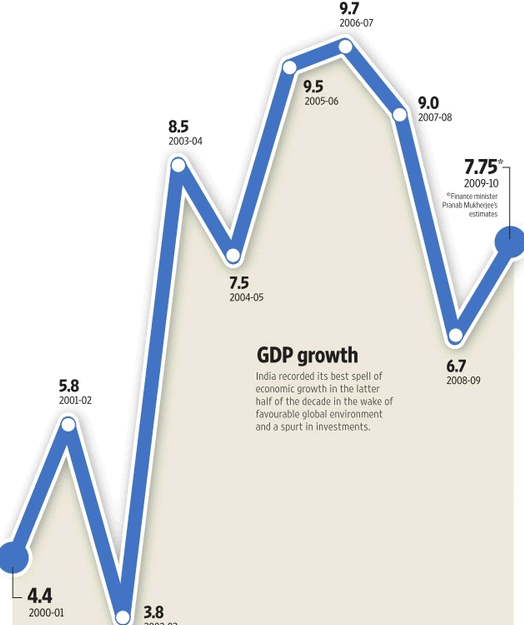
Indian economy is likely to grow between 6.1% to 6.7% in 2013-14 as the downturn is more or less over and the economy is looking up. Following the slowdown induced by the global financial crisis in 2008-09, the Indian economy responded strongly to fiscal and monetary stimulus and achieved a growth rate of 8.6 per cent and 9.3 per cent respectively in 2009-10 and 2010-11, but due to a combination of both external and domestic factors, the economy decelerated growing at 6.2% and an estimated 5% in 2011-12 and 2012-13 respectively. The Economic Survey 2012-13, presented by the Finance Minister Shri P. Chidambaram in the Lok Sabha predicts that the global economy is also likely to recover in 2013 and various government measures will help in improving the Indian economy’s outlook for 2013-14. While India’s recent slowdown is partly rooted in external causes, domestic causes are also important. The slowdown in the rate of growth of services in 2011-12 at 8.2%, and particularly in 2012-13 to 6.6 percent from the double-digit growth of the previous six years, contributed significantly to slowdown in the overall growth of the economy, while some slowdown could also be attributed to the lower growth in agriculture and industrial activities. But despite the slowdown, the services sector has shown more resilience to worsening external conditions than agriculture and industry. For improved agricultural growth, the survey underlines the need for stable and consistent policies where markets play an appropriate role, private investment in infrastructure is stepped up, food price, food stock management and food distribution improves, and a predictable trade policy is adopted for agriculture. FDI in retail allowed by the government can pave the way for investment in new technology and marketing of agricultural produce in India. Fast agricultural growth remains vital for jobs, incomes and food security.

The survey points out that the priority for the Government will be to fight high inflation by reducing the fiscal impetus to demand as well as by focusing on incentivizing food production through measures other than price supports. But unlike the previous year, when food inflation was mainly driven by higher protein food prices, this year the pressure has been coming mainly from cereals. On the Balance of Payments and External Position, the survey highlights that with net exports declining, India’s balance of payments has come under pressure. Moreover, in the current fiscal, foreign exchange reserves have fluctuated between US$ 286 billion and US$ 295.6 billion, while the rupee remained volatile in the range of Rs 53.02 to Rs 54.78 per US dollar during October 2012 to January 2013.

The survey had a special chapter focusing on jobs. The future holds promise for India provided we can seize the “demographic dividend” as nearly half the additions to the Indian labour force over the period 2011-30 will be in the age group 30-49. India is creating jobs in industry but mainly in low productivity construction and not enough formal jobs in manufacturing, which typically are higher productivity. The high productivity service sector is also not creating enough jobs. As the number of people looking for jobs rises, both because of the population dividend and because share of agriculture shrinks, these vulnerabilities will become important. Because good jobs are both the pathway to growth as well as the best form of inclusion, India has to think of ways of enabling their creation.

The survey calls for a widening of the tax base, and prioritization of expenditure as key ingredients of a credible medium term fiscal consolidation plan. This along with demand compression and augmented agricultural production should lead to lower inflation, giving the RBI the requisite flexibility to reduce policy rates. Lower interest rates could provide an additional fillip to investment activity for the industry and services sectors, especially if some of the regulatory, bureaucratic, and financial impediments to investment are eased. On financial sector reform, it takes note of the high level of gross NPAs (non-performing assets) of the banking sector which increased from 2.36 percent of the total credit advanced in March 2011 to 3.57 percent of total credit advanced in September 2012. The survey suggests that revival of growth will help contain NPAs, but more attention will have to be paid to whether projects are adequately capitalized up front given the risks. Expenditure on social services also increased considerably in the 12th Plan, with the education sector accounting for the largest share, followed by health. In the 11th Plan period nearly 7 lakh crore rupees has been spent on the 15 major flagship programmes. A number of legislative steps have also been taken to secure the rights of people, like the RTI, MGNREGA, the Forest Rights Act, AND THE Right to Education. However, the survey notes that there are pressing governance issues like programme leakages and funds not reaching the targeted beneficiaries that need to be addressed. Direct Benefit Transfer (DBT) with the help of the Unique Identification Number (Aadhaar) can help plug some of these leakages. With the 12th Plan’s focus on ‘environmental sustainability’, India is on the right track. However, the challenge for India is to make the key drivers and enablers of growth-be it infrastructure, the transportation sector, housing, or sustainable agriculture-grow sustainably.

Dr. Raghuram G. Rajan, Chief Economic Adviser, Ministry of Finance writes in an introduction to the Survey that these are difficult times, but India has navigated such times before, and with good policies it will come through stronger. Slowdown is a wake-up call for increasing the pace of actions and reforms. The way out lies in shifting national spending from consumption to investment, removing the bottlenecks to investment, growth, and job creation, in part through structural reforms, combating inflation both through monetary and supply side measures, reducing the costs for borrowers of raising finances and increasing the opportunities for savers to get strong real investment returns.
Read the rest of this entry

Budget 2013-14: Focus more on Education?

IN · · Leave a Comment

The finance minister P. Chidambaram will table the Union Budget 2013-14 in Lok Sabha today. What could be there in the budget , when the economy is reeling under the economic slowdown?


Entire focus is on the fiscal roadmap for the development or boosting the economy. And the budget would also feature some of the core aspects toward achieving higher growth rate and lower fiscal deficit.


Will there be a prominence for education or higher education in the budget? Will the government introspect into the loss to education sector due to the slowdown. Is is possible that there would be more education cess, which would yield more revenue for the eduction sector.

The expenditure on the education would be hardly around 1 per cent of the GDP. Most the the institutes and colleges were affected due the slowdown or downturn. The slower growth rate of the economy has been taking toll on the job market, and ultimately on the eduction sector.

It would be interesting to see, if the government declares more measures for the education sector in the budget that is going to be tabled today in Parliament.
Read the rest of this entry

Feb 27, 2013

Economic Survey 2012-13 tabled in Parliament

IN · · Leave a Comment

The Union Finance Minister P. Chidambaram presented the Economic Survey 2012-13 in Lok Sabha on Wednesday. According to the survey, the Indian economy would grow at 6.1 – 6.7% in the next fiscal year 2013-14, and the inflation could remain at 6.2-6.6%. In January 2013 the headline inflation was at 6.67 per cent.

The survey says "the slowdown is a wake-up call for increasing the pace of actions and reforms." There could be more economic reforms from the government to boost the economy during the slowdown. The survey has also suggested lower the fiscal deficit and curb on imports to strengthen the economy.

The fiscal deficit would remain at 5.3 per cent as the government projected for the fiscal year 2012-13 and would aim to reduce it to 4.8 pct of GDP in 2013-14. There is target to bring down the fiscal deficit to 3 per cent by 2016-17.

The industrial output would be 3 per cent for the fiscal year 2012-13.

There is need to have lots of fiscal consolidation since the economy has been reeling under the global downturn.

Considering the fiscal deficit, the survey suggested for room for accommodative monetary policy with expected fiscal consolidation.

It also suggested to cut down the subsidies to ease the burden on the economy, which could also help to check the widening fiscal deficit.

The finance minister will table the Union Budget for 2013-14 in the Parliament on Thursday in Parliament.
Read the rest of this entry

Feb 26, 2013

Railway Budget 2013-14: Highlights

IN · · Leave a Comment
railway-budget 2013-14
The Union Railway Minister Pawan Kumar Bansal has presented the much awaited railway budget for the fiscal 2013-14. The maiden railway budget of Mr. Bansal was passengers friendly, as there was no hike in the fares mentioned in the budget. But for Talkal or cacelling ticket would cost more for the passengers, as the minstry to cover the loss from these sources.

The fares were hiked in January 2013 by the Railway Ministry.

Introduced 67 Express Trains and 27 passenger train in the budget.

The last year’s railway budget was presented by former minister Dinesh Trivedi on March 2012, which focused to invest Rs.7.35 lakh crore in 12th Five year plan by railways.

In the Raiway Budget for 2013-14, 1.05 lah crore expenditure in the 12th Five Year Plan.

West Begal people have been disappointed with the railway budget. There is some special attention to Odisha state in this budget.

Citing the financial position, the railway minister told that the railway has repaid the loan of 3000 crore taken from the finance ministry.

Here are the highlights of Rail Budget 2013-14:
Railway has taken measures for Passenger Safety;
Try to work for zero train accidents;

13530 unmanned railway crossing present in India;

Plans to not add new level crossings;

Railway will upgrade tracks for the safety;

Rehabilitation for 17 distorted bridges by next year;

Women Passengers’ Security:
The Railways will create four more companies of Women Railway Protection Force

10% reservation for Women in recruitment of RPF;

Security Help Line numbers at Zonal Station to help women passengers;

Set up 8 Women Police Units;

Betterment of Sanitation and Cleanliness:
Will encourage bio-toilets in Trains,

Mechanized cleanliness in trains,

On-board housekeeping team in trains,

Facilities:

Free Wifi Connectivity in trains;

To avail First Aid facility at railway stations;

Special Coaches with All Amenities

“Anubhuti” named special coaches to be added to train, those will coach have all the facilities for the comfort of the passengers.

Special Attention towards Disabled Passengers:
For the comfort of disabled persons, the railways will install 179 escalations, 400 lists in railway stations;

Stations to be wheelchair friendly;


Adhar Card for Traveling

The Railways will use the data of Adhra card for various purposes, the minister had meeting with the UID chief Nandan Nekineni for this.

Internet/Online Booking Tickets:
Now the booking of ticket through online will be easy as the minister has been aiming to make it more effective user friendly.

1.20 lack users can book tickets through the IRCT website; currently 40,000 users have been able to book tickets simultaneously from the website.

Also working towards mobile ticketing;

Food Quality:
The railway has been taking to carter best quality food to passengers in trains.

Will consider for ISI certification of the vendor to carter food to passengers,

For grievances the Railway set up toll free number 1800 111 321 to complaint about the issues with the authorities.

Education for Youth to Know Freedom Movement:
Azadi Express – special trains to run across the state to educate youth and people about the freedom movement of India.

Freight Equations
India railways to join 1 billion freight club with China and Russia in the world;

Special Attention to North Eastern India:

For the first time the Arunachal Pradesh was brought into Indian Railway network ,

Railway infrastructure strengthened in Manipur.

Foot Over Bridge:
The Railways will be interested to work with the state governments over construction Foot Over Bridges near stations for the passengers.

Attention to Odisha

Special attention given to Odisha in the Railway budget, as the minister declared to set up Maintenance Workshop at Kalahandi. Wagaon Factroy in Ganjam district, a skill development centre in Koraput district.

Freedom Fighters Renewal:
The renewal of freedom fighters quota has been increased to 3 years , currently it was one year term.
Read the rest of this entry

Feb 22, 2013

Budget Blues: Follow Canons of Taxation

IN · · Leave a Comment
As a student of economics, it is always fun to read about the canons of taxation in public finance.

Economists do always favor the changes of the fiscal policies and taxation in an economy to keep it fit and healthy.

India is going to witness the union budget for the fiscal year 2013-14 and the taxation is the prime concern for many in the country from individual tax payers to corporates.

There are many canons of taxation or principles of taxation in Indian economy too, alike other economies the world have.

It may be direct tax or indirect tax changes, it is sure to affect the budget of everyone in the country, and thanks to tough job to be done by the finance minister and administrative officers those always aim to minimize the burden of taxation.

When it comes to taxation in the country, the job becomes tougher for them. They need to strike a balance between the sentiments of the people using canons of taxation and fiscal consolidations.

Let’s have a look on the statistics, tax revenue as a percentage of GDP declined from 8.8 per cent in 2007-08 to 7.5 per cent in 2001-12.
canons of taxation
Goods and Services Tax (GST) has been major concern for the economic planners while dealing with the debt consolidation, fiscal deficit and current account deficit.

Will there be rise in indirect tax in India? Will there changes in the income tax-slabs? How much I need to pay as tax? Will the EMI of home loan go up after the union budget?

There are basic questions one has in mind when the person thinks about the budget outcome. On Thursday, the budget session has been stared in Parliament with keynote address by the President of India.

Sine the economy growth rate is lowest in decade around 5 per cent and the fiscal deficit is high, it is obvious that the government would look for more adjustment in the taxes or disinvestments of PSUs.

Interestingly, the government needs to work on the framed rules or canons of taxation simultaneously working on fiscal deficit and adjusting taxation.

In the gloomy situation, there could be chances of higher taxes in India, but there might not be if the government prefers to present a popular budget as the general election will be held in 2014.

Best way to judge economy is to see the cannons on taxation used. 
Read the rest of this entry

Feb 20, 2013

Odisha budget for 2013-14: Highlights

IN · · Leave a Comment
odisha assembly
Reading the Odisha budget speech, the finance minister Prasanna Acharya presented at revenue surplus budget for 2013-14 contains total outlay of Rs 60303.09 crore. Which is 20 per higher than the previous budget presented by the former finance minister Prafulla Chandra Ghadai of Rs. 52,030.70 crore for the year 2012-13.

According to the government data, the state government projected a revenue surplus of Rs 1904.61 crore that weighs 0.65 per cent of gross state domestic product (GSDP).

Prominence has been given to agriculture sectors, as the Chief Minister Naveen Patnaik told media that “In the history of Odisha Budget, it is for the first time that we have placed a separate agriculture budget. In this budget, we have given emphasis on agriculture & allied sectors.”

Odisha Budget Highlights
  • The total budget outlay has increased from ­Rs. 52030.70 crore in 2012-13 to ­ ­Rs. 60303.09 crore in 2013-14. The overall increase in budget size is about 16%.
  • The outlay for the State’s Annual Plan 2013-14 has been fixed at ­ ­Rs. 21467 crore for the financial year 2013-14, which includes an outlay of ­ ­Rs. 19367 crore for the Government sector and ­2100 crore for the Public Sector Undertakings. 
  • The size of Non-Plan expenditure is contained with a growth rate of only 10.5% to create more fiscal space for plan investment. 
  • Thus, there is 27.4% increase in State Plan provision in Government sector from ­ ­Rs. 15200 crore in 2012-13 to ­ ­Rs. 19367 crore in 2013-14. 
  • The Plan: Non Plan ratio has gone up from about 27% in 2006-07 to about 59% in 2013-14. This is the highest ever ratio achieved by Odisha. 
  • Total Capital Outlay has been increased to ­ ­Rs. 7840.13 crore. Besides, ­3496.45crore has been provided as grants for creation of capital assets. 
  • The Budgeted Expenditure for 2013-14 will be financed through estimated revenue receipts of ­Rs. ­51298.98 crore, recovery of loans and advances of ­ ­Rs. 240.29 crore and borrowing and other receipts of ­Rs. ­8763.82 crore. 
  • Revenue surplus of ­ ­Rs. 1904.61 crore has been projected in the Budget Estimatesfor 2013-14 which is 0.65% of GSDP. 
  • The Fiscal Deficit is projected at ­ ­Rs. 5945.13 crore which is 2.03% of GSDP. 
  • The yearend debt stock for the financial year 2013-14 is estimated at ­Rs. ­45561.12 crore which is 15.58% of GSDP. 
  • The interest payment to revenue receipt ratio is estimated at 9.76% for 2013-14. 
  • Thus, the Annual Budget for 2013-14 is fully compliant to provisions of FRBM Act.
Agriculture Budget Highlights
  • For the first time, the State has prepared a separate Agriculture Budget for the development of the agriculture and allied sectors as well as welfare of the farming community.
  • Odisha is the second State in the country after Karnataka to present a separate budget for agriculture and allied sectors. 
  • The allocation for agriculture and allied sectors in this Budget has been substantially enhanced from ­ ­Rs. 5627.87 crore in 2012-13 to ­Rs. ­7161.84 crore in 2013-14. 
  • The step up in provision in the sector is more than 27%.
Natural Calamity
  • Provision of ­Rs. ­453.31 Crore and ­ ­Rs. 200.00 Crore have been made towards State Disaster Response Fund (SDRF) and National Disaster Response Fund (NDRF) respectively in the BE for 2013-14 under Non-plan.
Read the rest of this entry

Feb 14, 2013

Budget Session begins in Odisha

IN · · Leave a Comment
odisha assembly
The budget session has began in Odisha assembly on Thursday. The people of Odisha may witness some major outcomes from the state budget once it is presented by the state finance minister in the assembly.

As expected, there would be uproars also in the assembly from the opposition parties to corner the ruling party BJD.

Congress and BJP may raise all the current issues of the state during the assembly session to grill the state government.

There are many political issues, those could be given priority by the opposition parties in the house for discussion including – declaration of pro-poor scheme (one rupee per kg subsidised rice scheme), Posco land acquisition row, the deteriorate law and order in the state.

Allocation to state from the railway budget could also be another issue for the opposition parties.
Read the rest of this entry

Feb 12, 2013

Financial Prospects in the Fiscal Year 2013-14

IN · · Leave a Comment
union budget 2013-14
Many changes in the financial prospects are possible in the fiscal year 2013-14.Union budget for the last fiscal year will be tabled in the Parliament by the finance minister.

It is expected that, the government could table a populist budget in order to give some relief to the people those have been reeling under the pressure high-inflation, high fuel prices and low income-tax slabs.

Keeping the possible budgetary policy for the fiscal year, it could guess that there would be lot changes in the financial prospect in the year 2013-14. 

It is going to affect all the budges including household, industry and economy. The price of goods and services have gone up due to the impact of hike in the petrol and diesel.

Before the union budget, the people will see railway budget allocation, and chances are there there could rise in the freight charges in the railway budget as the passengers fairs have already been hiked in the last month.

Any hike in the freight would help the inflation to back into its massive form, which has been moderating, and considering moderation in the headline inflation the RBI cut the key interest rates.

It is sure that the changes in the income tax slabs going to change the financial prospect and individual preferences. The industrial bodies would be recommending the finance minster for a soft hear towards the corporate taxes in the budget 20013-14.

The health of India economy would also be big concern as the poor performance of agriculture and mining sectors cause a low growth rate of 5 per cent.

In a nutshell,  it is clear that there has been slowdown and everybody is going to affect in terms for the financial prospect in the fiscal year 2013-14.
Read the rest of this entry

Feb 7, 2013

Indian Economy's GDP Pegged at 5%

IN · · Leave a Comment

Indian economy
The government of India has estimated the Gross Domestic Product (GDP) rate at 5 per cent for the fiscal year 2012-13, which is much lower from the projection of 5.5 per cent.

According to the Advanced Estimates released today by the Central Statistical Organisation (CSO), the economy would like to have 5 per cent GDP growth rate during 2012-13.

In 2011-12, the GDP was at 6.2 per cent. The slide in the growth rate of Indian economy has been indicated that it is reeling under the clutches of global slowdown.

The poor performance of many sectors of Indian economy hold the growth rate to much lowest level of 5 per cent.

On Thursday, after estimation of the GDP of Indian economy, the Sensex went down by 56.78 points at 19,582.94 points. The Nifty was also seen in red in post lunch session, it was at 5,937.95 points shedding 21.25 points or 0.36% loss.
Read the rest of this entry

Jan 16, 2013

Expectations from the Union Budget 2013-14

IN · · 2 comments

The finance minister of India will present the union budget for the fiscal year 2013-14 in the Parliament in February 2013. The people of India have various expectations from the union budget.

There have been many macro-economic issues related to common-men, Aam Admi in this country, who may get some good relief in terms of many schemes and services if declared in the forthcoming budget.

The government may try to fulfil the demands of the people in the budget, but it has some limitations, as it needs to take care of the economy, which has been facing the global slowdown.

The cap on the LPG usage for customers was the major setback for the users, but the implementation of cap on number of LPG cylinders, the government could able to check around 700 crore rupees subsidies in the few months.

And in long-run, it may give more and more check on subsidies, which could help the economy to bounce back from the glow growth to fast pace race.

Income Tax: There may be some changes in the income tax slabs to give some relaxation to the families reeling under the pressure of the high inflation, high fuel prices, and cap on LPG usage. There might be some good news for the senior citizens and women in income tax filing. There may be little variation in the current income tax slabs, which may give a minor relief to the income tax payers, as the government has been on a path for economic reforms to boost the economy.

Agriculture: Major focus could be given to agriculture and the subsidies for farmers. Monsoon was normal the year so as the cultivation in the country last year and there may be some more relief from the government over crop credits for farmers. There may be some more measures to ensure the contribution from agriculture sector to the GDP.

Senior Citizens: In the forthcoming budget, the senior citizens might get some special attention in the entire scheme meant for them by the government of India. The security of senior citizens, travelling and pension could be given more priority. The interest rates for the deposits by senior citizens might get more interest rate on those.

Subsidies: The government may take some good measures to back its economic reforms while focusing on the subsidies. But the expectations would be on the contrary to the approach of the government in checking the subsidies. People would have to have subsidies to make their life easy, while the government is trying to keep the fiscal deficit around 5.3 per cent. It’s very hard for the government keep fiscal deficit low with having more and more subsidies.

Though the government is on a path of economic reforms but will try to meet the expectation of the people by presenting them a popular union budget for 2013.
Read the rest of this entry

Jan 3, 2013

Indian Economy to Recover from Slowdown?

IN · · 1 comment
indian economy
Indian economy will recover from the clutches of the slowdown. The GDP growth rate might project at 5.7 per cent for the fiscal year 2012-13, but it will revive its position from there, with help of some good economic reforms.

The UPA government has initiated the economic reforms, which are actually terms are 'need of the hour' and would boost the Indian economy.

Some tough decision like reducing sub-sidies on energy products would be consider to give a relief to oil companies from dipping further into losses. However, the hike in petrol or diesel prices, are going to affect the budget of common men.

The decision of such, would be against the people but necessary to keep up the growth momentum. The target set of 8 per cent growth rate for Indian economy in the 12th Five Year Plan is enough to indicate the possible economic reforms the government would consider to achieve it.

It is clear that in the year 2013, people might need to lose some extra money on their transport following further possible hike in the petrol and diesel prices.

The union budget 2013-14 will be tabled in Parliament in the month of February 2013, by the finance minister. It is speculated that the budget would  aim for clear revive of economy from the clutches of economic slowdown.

On the other hand, if the trend of populist budget follows keeping the 2014 election, then the revival of India economic growth might be in trouble. Since, India will witness its mega election battle for Lok Sabha, in 2014 general election involving huge expenditure of government fund.

And subsidies may be high to keep all sectors happy,that also would weight high on Indian economy. There are two sides of coin, one side good economic reforms and the other side is to give plenty of subsidies to back into the power gain. There are options, lets wait and watch which side of the coin will fall, after toss.
Read the rest of this entry

Dec 13, 2012

Indian Economy: Threat of Downgrade Rating

IN · · Leave a Comment
Indian Economy
The world economy is reeling under the economic slowdown so as the Indian economy. There are threats for it to get downgrades from various rating agencies in the days to come. The macroeconomic growth has been a big concern.

The global rating agency Standard & Poor has a rating of BBB (Minus) on India. And there are chances of downgrade if Indian economy will be in further dim growth prospects by next couple of years.

Following reasons could be major to avoid any downgrade further:

Fiscal Deficit:
Fiscal Deficit could be the first major reason for such speculations. According to media reports the fiscal deficit of Indian economy for 2012-13 could be 5.5-5.6 per cent of GDP. That is much higher from the 5.1 percent target. But it may be lower than last year’s figure are 5.8 per cent.

For the government it is very hard to keep the fiscal deficit low because of the subsidies on various sectors. In order to avoid and downgrade from rating agencies, the government would look for options to check the fiscal deficit either bringing more economic reforms or borrowing extra fund from the market.

The Union Budget 2013-14 will be present by the finance minister in March 2013. And the budget will give the clear picture of the growth of Indian economy.

High Inflation Rate and Internet rates:

The high inflation rate in India could be the second major concern for the UPA government to address. The annual rate of inflation (WPI) was at 7.45 per cent (provisional) in October 2012, while it was at 7.81 per cent (provisional) in October 2011.

The apex bank, Reserve Bank of India, will review its credit policy on this week, and it may try to adjust the interest rates to tame the high inflation rates keeping the interest of the investors in India.

There might be some changes in the interest rates to boost the liquidity in the market. The apex bank may infuse some more money in to economy to check the high inflation rates.

Economic Reforms & Obstacles:

The Foreign Direct Invest in retail has been through in Parliament last week by voting followed by two days long debate. It shows that the economic reforms could help the economy to stand and face the economic slowdown, but the path is not easy job for the government to act on.

Despite after the getting the nod of the Parliament over the FDI in retail, still the road for reforms not clear for the government which has been facing the opposition over the lobbying matter. The process of the economic reforms may see slow progress as only two years left for the General elections in India that is going to be held in 2014.

Political Scenario:

The current political scenario has been the major concern for the investors to keep their interest up on the stock markets. The coalition politics has been the recent trend in Indian political system for last decade. But for major improvement in the rating, there should be a stable government, which should be free from pressure of any ally to initiate any reforms.

It does not matter which party is going to form the government but the concern is how strong it would be to carry forward the Indian economy further towards growth.

The bottom-line is the growth rate of Indian economy is completely depending upon the government mechanism to check inflation, fiscal deficit, debt burden.
Read the rest of this entry

Oct 11, 2012

Is the Budgeting Exercise of any Use?

IN · · Leave a Comment
Budgeting
To run a home with four or five people, with a limited income, we need to plan and budget. Just think about a nation, its people vast and never ending needs. Without a budget we hardly know where we will go and land. When we budget, we know where we need to spend the money, and how much what the priorities are. Without budget you never know how much you need to spend and in what areas.

There are definitely many uses of the budgeting exercise. First, it helps us to have a look at the needs of the country, what are our basic needs how much do we need and to what time to do what? All these details we come to know only when we budget. There will be many aspects that need to be taken care of, when we think of a country. Peoples, educational needs, health needs, loans taken from the other countries and World Bank. Budgeting for infrastructural development, completion of projects.

On top of it resources and funds should be set aside for the development of research and most important of all, for the security and safety of the nation, funds should be allotted to the defense. Funds should be set aside for subsidies, natural calamities. And the list goes on and on. It is just impossible to run a country and to take it on a progressive way, if there is no budgeting.

You don’t know the priorities, when you don’t budget, you don’t know where you need to spend the money. You never know if you will be spending money on unnecessary, matters. So the uses of budgeting are limitless, and the truth is that budgeting is a need, not an option that we have, to see if we have any uses we will budget or otherwise no.
Read the rest of this entry